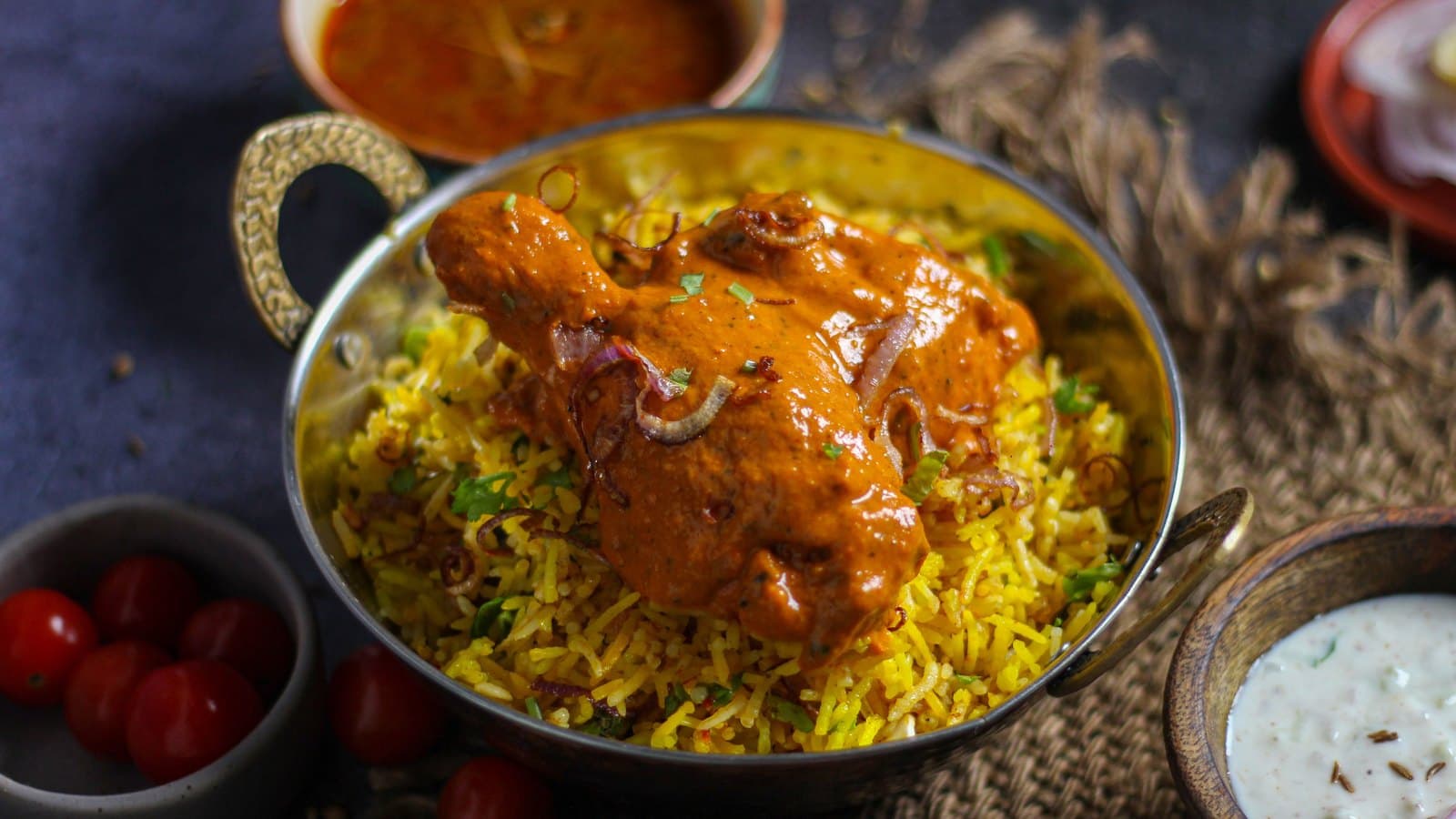
Ask how many calories are in a plate of biryani and you get one confident number, quoted to the single calorie, with no source attached. The problem is not that nobody has measured biryani. It is that three separate published sources have, and they disagree by more than five times.
USDA's dietary survey database puts a cup of chicken biryani at about 204 kcal. The peer-reviewed Indian Nutrient Databank lists mutton biryani at 190.76 kcal per 100 g. One US restaurant group publishes 1,142 kcal for its own chicken biryani platter. The distance between them is not an error. It is the ghee, the rice quantity and the size of the plate.
So this post takes the dish apart. Each component gets the best published figure that exists, with its FoodData Central ID named inline, and anything built from ingredients states its assumption. Where no honest number exists, and for one component here there genuinely is none, we say so rather than invent one.
Table of Contents
- Why No Single Number Exists
- Three Published Values That Disagree by Five Times
- The Rice: The Biggest Term
- The Ghee You Cannot See
- The Chicken: Bone Weight and Skin
- Birista: The Component With No Honest Number
- The Egg and the Raita: Genuinely Small
- The Whole Plate at a Glance
- Why Two Plates of Biryani Differ by Hundreds of Calories
- How to Estimate Your Own Plate
- FAQ
- The Bottom Line
Why No Single Number Exists
Nothing published anywhere measures the biryani on your plate. What exists are three things mistaken for that: a US dietary-survey recipe, an Indian research recipe, and one restaurant chain's disclosure for its own platter. Each is honest about what it is. None is your plate.
India's ICMR-NIN Indian Food Composition Tables 2017 do not fill the gap, though they are often cited as if they did. Searching the full IFCT 2017 text for "biry", "biria", "pulao" and "pilaf" returns zero matches across more than three million characters. It covers 528 raw food items and no cooked composite dishes at all, the same gap we hit writing about rice and curry calories and unpacked in our guide to the best calorie counter for Indian food.
Three Published Values That Disagree by Five Times
| Source | What it measures | Published value | The catch |
|---|---|---|---|
| USDA FNDDS 2706538 | Chicken biryani, US survey recipe | 104 kcal per 100 g, about 204 kcal per 196 g cup | Under 1 percent butter, more potato than chicken |
| USDA FNDDS 2706490 | Biryani with meat, US survey recipe | 145 kcal per 100 g, about 284 kcal per 196 g cup | Same lean method, richer meat |
| Indian Nutrient Databank ASC122 | Mutton biryani, Indian research recipe | 190.76 kcal per 100 g | Serving is "1 plate", no gram weight given |
| Indian Nutrient Databank ASC123 | Vegetable biryani, Indian research recipe | 174.61 kcal per 100 g | The database holds no chicken biryani |
| Tiffin Indian Restaurants disclosure | Chicken biryani, one restaurant platter | 1,142 kcal, 27 g fat, 169 g carbohydrate | One restaurant, not an authority, dated 2016 |
The USDA record's own ingredient list explains its leanness: 2,966 g of raw inputs, of which just 28 g is butter, with 668 g of potato against 576 g of skinless rotisserie chicken. That is a modest home-style biryani, not a ghee-layered restaurant one.
The Indian figure comes from the Indian Nutrient Databank, published with Vijayakumar A and colleagues, "Development of an Indian Food Composition Database", Current Developments in Nutrition, 2024;8(7):103790. Its mutton recipe uses 100 g rice, 100 g boneless mutton, 100 g onion and 4 tablespoons of fat for 2 plates, and lands about 83 percent denser per 100 g than the USDA chicken recipe. The added fat is the reason.
The restaurant figure comes from Tiffin Indian Restaurants' nutrition disclosure, effective June 1, 2016. It survives two checks: it is internally consistent, since 54 g protein and 169 g carbohydrate at 4 kcal per gram plus 27 g fat at 9 gives 1,135 against the stated 1,142, and the same menu's plain basmati side is 218 kcal with 1 g of fat, so the biryani carries 27 times that side's fat. Divided by the USDA cup value, the platter is roughly 5.6 survey cups: a multiple of a modest serving, not a variant of it.
The Rice: The Biggest Term
FoodData Central publishes no food named basmati, but it does something better than leave a gap. Six cooked white rice records carry the additional description "basmati or jasmine rice" (FDC IDs 2708403 through 2708408), so USDA itself treats cooked white rice as the right entry for basmati rather than a proxy for it. The fullest published record for it is cooked long-grain white rice: 130 kcal per 100 g, with a published 158 g cup, about 205 kcal (FDC ID 168878). One cup versus two is a straight extra 205 kcal.
That record is also nearly fat-free at 0.28 g per 100 g, which matters: every gram of fat in a biryani arrived from the pot, not from the grain. And USDA lets us price the pot without any assumption, because it publishes the same rice cooked both ways. With no added fat (FDC ID 2708408) a 158 g cup is about 204 kcal. With fat added (FDC ID 2708407), 148 kcal and 2.77 g fat per 100 g, a 163 g cup is about 241 kcal.
So cooking the rice in fat adds roughly 37 kcal per cup, about 18 percent, before a spoon of ghee touches the layers. The butter-specific variant (FDC ID 2708405) is 147 kcal per 100 g with its own published 163 g cup, about 240 kcal, the closest single-fat analogue to ghee-laced biryani rice. These are survey records for rice cooked with fat generally, not measurements from a biryani pot.
The Ghee You Cannot See
Ghee has a real named record and needs no proxy: 876 kcal and 99.5 g fat per 100 g, with a published 14 g tablespoon at about 123 kcal (FDC ID 2710168).
How much reaches a plate is where assumptions get smuggled in, so here are two independent sources that converge. The Indian Nutrient Databank recipe uses 4 tablespoons of fat for 2 plates, about 2 each. The Tiffin platter carries 27 g of fat against 1 g in its plain rice side. Two tablespoons is about 245 kcal, and both point roughly there. The USDA survey recipe, under 1 percent butter, is exactly why it lands at 104 kcal per 100 g.
Ghee is essentially pure fat, so it adds no bulk: no extra grain, no extra meat, nothing visible. It is the calorie term you cannot see, and the main difference between a home biryani and a restaurant one.
The Chicken: Bone Weight and Skin
For a leg piece braised under the rice, the closest record is "Chicken leg, drumstick and thigh, stewed, skin eaten" (FDC ID 2705988) at 211 kcal and 13.4 g fat per 100 g. USDA's leg weights give about 274 kcal for a small piece at 130 g, 327 kcal for a medium at 155 g and 422 kcal for a large at 200 g.
Now the part that fools anyone with a kitchen scale. Every gram weight USDA publishes for a chicken piece is edible yield, not the served piece: the portion label reads, verbatim, "1 leg quarter (yield after cooking, bone removed)". Weigh a bone-in piece at 220 g, multiply by 211 per 100 g, and you have counted bone as chicken. We will not quote a percentage for how much of a piece is bone, because the record carrying that figure was not retrieved for this post and guessing it is the exact kind of invention this blog exists to avoid. The rule stands without it: log the meat you actually eat.
The skin is a separate record. "Skin not eaten" (FDC ID 2705989) is 164 kcal and 7.5 g fat per 100 g, an edible 130 g, about 213 kcal, labelled "yield after cooking, bone and skin removed". One medium leg is about 327 kcal with skin and 213 without, a 114 kcal swing decided after the photo is taken.
Birista: The Component With No Honest Number
Birista, the sliced onion fried down dark and scattered through the layers, has no FoodData Central record. All 12 FNDDS records beginning with "Onion" include no deep-fried plain onion, and the two nearest candidates are wrong in specific ways.
"Fried onion rings" (FDC ID 2710055) looks close at 352 kcal and 19.8 g fat per 100 g, but it is battered, so much of that is fried batter, 39.9 g of carbohydrate per 100 g, not onion plus absorbed oil. "Onions, cooked, fat added" (FDC ID 2709951) at 73 kcal per 100 g errs the other way: sauteed, nowhere near birista's oil uptake.
The shape of the problem can still be stated honestly. Raw onion is cheap at 38 kcal per 100 g, about 61 kcal per 160 g cup (FDC ID 2709795); the finished garnish is not; and the whole difference is absorbed frying oil with no published value, the same gap as deep-fried papadam. To size it, price the oil at 123 kcal a tablespoon and label that tablespoon an assumption, not a source.
The Egg and the Raita: Genuinely Small
The halved boiled egg is the component people most often overrate. "Egg, whole, boiled or poached" (FDC ID 2707154) is 143 kcal per 100 g with 12.4 g protein, so a 50 g egg is about 72 kcal. The neighbouring record for eggs with cooking method unspecified (FDC ID 2707153) is 176 kcal per 100 g because it averages equal thirds of a boiled egg, an egg fried in oil and an omelet made with oil; boiled or poached is the right record here.
Raita has no record either, so it has to be built with the assumption stated: half a cup of whole-milk plain yogurt, 122.5 g at 78 kcal per 100 g (FDC ID 2705418), is about 96 kcal, and 60 g of raw cucumber at 16 kcal per 100 g (FDC ID 2709784) adds about 10 kcal. Call the bowl 105 kcal, or about 87 kcal built the same way with low-fat plain yogurt at 63 kcal per 100 g (FDC ID 2705419). Tzatziki, the nearest published composite, is a poor stand-in because it carries added olive oil that raita does not.
The Whole Plate at a Glance
| Component | Portion assumed | Honest estimate (kcal) | Source basis |
|---|---|---|---|
| White rice, cooked without fat | 1 cup (158 g) | ~205 | USDA FDC 168878 |
| The same rice, cooked with fat | 1 cup (163 g) | ~241 | USDA FNDDS 2708407 |
| Ghee layered through the dish | 2 tablespoons (28 g), assumed | ~245 | USDA FDC 2710168 |
| Chicken leg, skin eaten | 155 g edible meat, no bone | ~327 | USDA FNDDS 2705988 |
| Chicken leg, skin left | 130 g edible meat, no bone or skin | ~213 | USDA FNDDS 2705989 |
| Birista, fried onion garnish | A scattered handful | No published value, the absorbed oil is unmeasured | Nearest proxy is battered onion rings, USDA FNDDS 2710055 |
| Boiled egg | 1 egg (50 g) | ~72 | USDA FNDDS 2707154 |
| Raita | Half cup yogurt plus 60 g cucumber | ~105 | Built from USDA FDC 2705418 and 2709784 |
One caution before anyone reaches for a calculator: the composite figures in the earlier table already contain their own rice, chicken and fat. Component sums and composite values are two alternative routes to an estimate, never terms to add together.
Why Two Plates of Biryani Differ by Hundreds of Calories
First, an admission about portion mass. Only the USDA survey publishes a gram weight at all, its 196 g cup. The Indian database says "1 plate" with no weight; the restaurant publishes calories with no weight. There is no authoritative gram figure for a plate of biryani, and any specific one you see was invented.
The levers are the ones priced above: a second cup of rice, whether that rice was cooked in fat, the two tablespoons of layering ghee, whether the chicken skin is eaten, and the unmeasured oil in the birista. A restaurant or wedding portion stacks every one of them at the high end at once, on a bigger plate. That is why a single dish name honestly spans a five-fold range.
How to Estimate Your Own Plate
- Size the rice first, in cups. It is the biggest term at roughly 205 kcal per cup and the one you can see.
- Decide whether this is a lean-pot biryani or a ghee-layered one, and add roughly 245 kcal if it is the second. You cannot spot ghee by looking, because it adds no bulk.
- Log the chicken as meat eaten, not the piece served, and be honest about the skin. That alone is worth over 100 kcal.
- Treat the birista as a known unknown, priced as a tablespoon of absorbed oil and labelled an assumption.
- Never add a composite figure and a component sum together. Pick one route and stay on it.
- Be consistent day to day. A steady estimate you can compare across weeks beats a precise-looking one-off.
This layered, mixed-plate problem is what an AI calorie counter built for South Asian food is meant to handle. CountNutri lets you photograph the meal so the AI identifies each element, rice, meat piece, egg, raita, estimates the portions and returns calories plus protein, carbs and fat cross-checked against USDA FoodData Central, with every item adjustable in a tap when it sizes your rice wrong. The 7-day free trial gives 1 AI scan a day, 7 in total; Premium is $9.99 a month and Ultra $99.99 a year, about 2 months free, each with 6 scans a day. For how mainstream trackers cope with this food, see our comparison in the MyFitnessPal alternative for Sri Lankan food guide.
FAQ
How many calories are in a plate of chicken biryani?
No source publishes a measured value for a plate as served, so there is no single honest number. The three named sources span roughly 204 kcal for a USDA survey cup to 1,142 kcal for one restaurant's platter, and rice quantity, ghee and portion size account for nearly all of that gap.
Why do the published biryani numbers disagree so much?
They describe different recipes. The USDA survey recipe is under 1 percent butter with more potato than chicken; the Indian research recipe uses about 2 tablespoons of fat per plate; the restaurant platter carries 27 g of fat against 1 g in the same menu's plain rice side.
Is basmati rice lower in calories than other rice?
FoodData Central publishes no food named basmati, but six of its cooked white rice records carry the additional description "basmati or jasmine rice" (FDC IDs 2708403 through 2708408), so cooked long-grain white rice is the entry to use, about 205 kcal per 158 g cup. The real difference comes from portion size and whether the rice was cooked in fat, not from the variety.
Should I weigh my biryani chicken with the bone in?
Weigh it if you like, but do not multiply that reading by a per-100 g value. Every USDA gram weight for a chicken piece is edible yield after cooking and deboning, stated on the record as "yield after cooking, bone removed". Log the meat you actually eat.
The Bottom Line
Biryani is not a dish with an unknown calorie count. It is a dish with three known ones that disagree by more than five times, and every part of that disagreement is traceable. The rice sets the floor at roughly 205 kcal per cup. Cooking that rice in fat adds about 37 kcal per cup. The layering ghee, invisible on the plate, adds around 245 kcal when two tablespoons go in. The skin on one chicken piece is worth over 100 kcal. The birista stays unmeasured until someone publishes a value for the oil it drinks.
Estimate in components, write your assumptions down, and never trust one confident number for a dish whose published values span five times over.
Ready to stop guessing at your own plate? Try CountNutri free.
Count calories from a photo instead
CountNutri reads your whole plate — including the mixed, home-cooked dishes that database apps break on — and returns calories, protein, carbs and fat in seconds, cross-checked against USDA data. Free 7-day trial, no credit card.