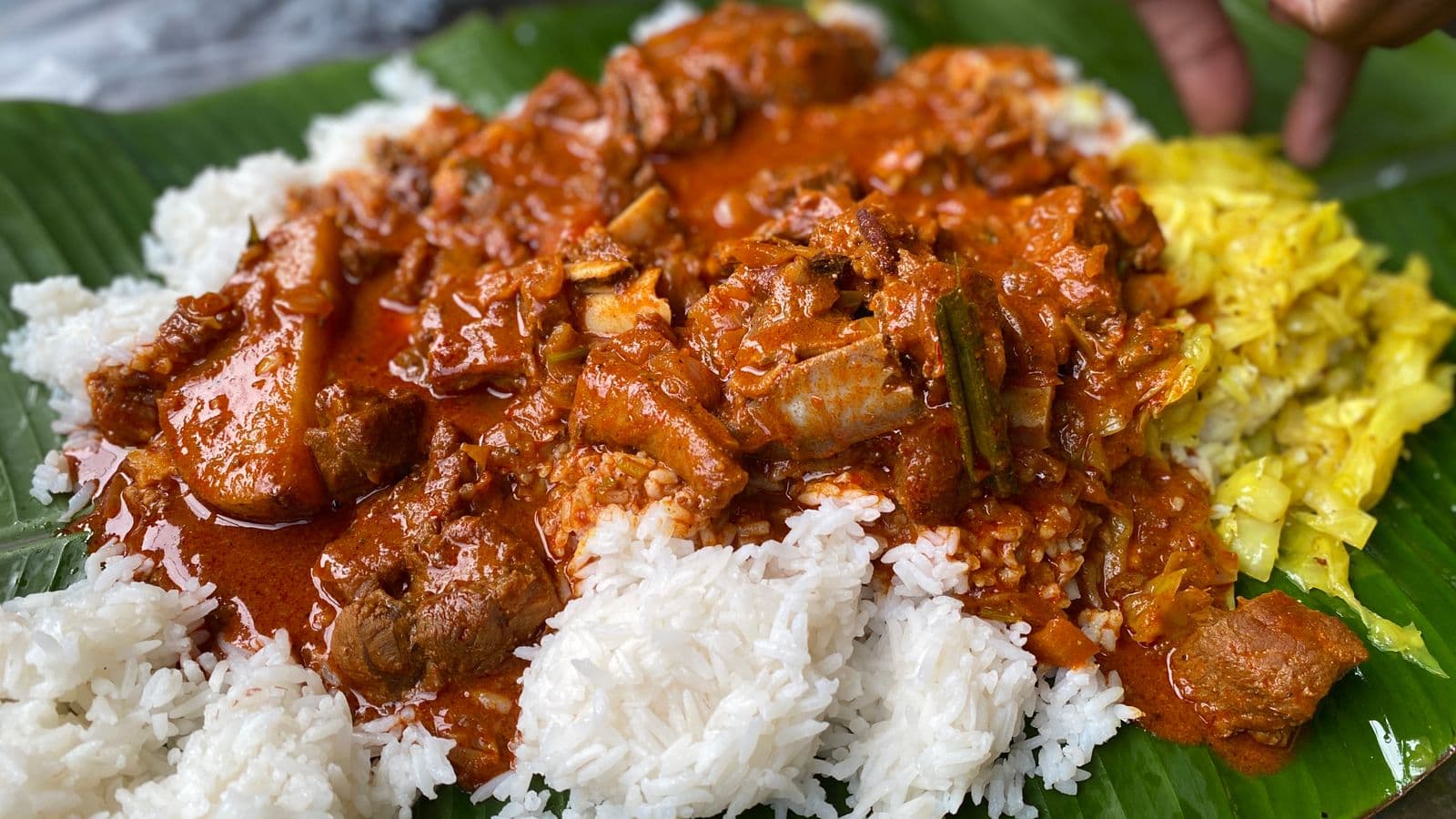
Nobody who serves you a plate of rice and curry weighs anything, and no authoritative body has published an official calorie count for the plate as it actually reaches your table. Search the question anyway and you will find suspiciously exact answers, quoted to the single calorie, with no source attached.
This post takes the opposite approach: one plate, taken apart. For each component we give the best published number that actually exists, name its source, and state the assumptions behind anything built from ingredients. Where no honest number exists we say so, because a stated range beats an invented figure every time.
By the end you will see why the same plate can plausibly land anywhere from roughly 600 to well over 1,100 kcal, and which levers move the total most.
Table of Contents
- Why There Is No Single Answer
- The Rice Mound: The Biggest Number on the Plate
- Dhal Curry: The Closest Published Numbers
- Pol Sambol and Mallung: Built From Ingredients
- Fish or Chicken Curry: A Range, Not a Number
- Papadam, Oil and Other Extras
- The Whole Plate at a Glance
- Why Two Plates of the Same Meal Can Differ by Hundreds of Calories
- A Lighter Plate vs a Richer Plate
- How to Estimate Your Own Plate
- FAQ
- The Bottom Line
Why There Is No Single Answer
There is no authoritative published nutrition value for a Sri Lankan rice and curry plate as served, nor for pol sambol, mallung or coconut-milk parippu as individual dishes, unlike chicken kottu, which does have one published figure. USDA FoodData Central has excellent ingredient data and a handful of US-survey curry recipes that work as rough proxies, but nothing measured from a Sri Lankan kitchen. India's IFCT 2017 tables publish ingredient values only and contain no cooked composite dishes at all, a gap we unpacked in our guide to the best calorie counter for Indian food.
That absence is not a technicality: every confident single number you see online for "a plate of rice and curry" was made up somewhere along the line. The honest method is to price each component separately, from real data, with portions stated.
The Rice Mound: The Biggest Number on the Plate
Start with the rice, usually the largest single term. USDA FoodData Central lists cooked white long-grain rice at 130 kcal per 100 g, with a 1-cup portion weighing 158 g, about 205 kcal per cup (FDC ID 168878).
For a real Sri Lankan serving: one level cup is about 205 kcal, one and a half cups about 308, two cups about 411. A generous lunch-packet mound is often closer to the two-cup end, so the rice alone can swing the plate by roughly 200 kcal before a single curry touches it.
Cooked white rice is also nearly fat-free (0.28 g per 100 g in the same record). Since fat carries 9 kcal per gram versus 4 for carbohydrate and protein (standard FAO conversion factors), every gram of fat on the plate comes from the curries, the sambol and the pan.
Dhal Curry: The Closest Published Numbers
There is no published value for Sri Lankan parippu as served. The closest is the USDA FNDDS survey food simply called "Dal" (FDC ID 2707427): 145 kcal and 4.31 g fat per 100 g, about 348 kcal for its 1-cup (240 g) portion, or roughly 174 kcal for a half-cup ladle. It is a US-survey recipe standing in for the real thing, not a measurement of your amma's parippu.
The biggest gap between that proxy and a typical Sri Lankan dhal is coconut milk. Canned coconut milk runs 197 kcal per 100 g (USDA FDC 170173), so a quarter cup stirred into the pot adds about 111 kcal to whatever share of it ends up in your ladle. A watery daily parippu and a thick kiri-heavy one are very different dishes wearing the same name.
Pol Sambol and Mallung: Built From Ingredients
Pol sambol has no authoritative published per-dish value, so we build it from its dominant ingredient. Fresh coconut meat is 354 kcal and 33.5 g fat per 100 g (USDA FDC 170169). A typical serving of sambol contains roughly 25 to 40 g of scraped coconut (2 to 4 heaped tablespoons), contributing about 90 to 140 kcal; the chili, onion, lime and Maldive fish add only a few more, so the coconut essentially is the number.
Mallung is the kindest dish on the plate. Boiled spinach, the closest USDA stand-in for cooked leafy greens, is just 23 kcal per 100 g, about 41 kcal for a full cup (FDC ID 168463). Add the 10 g of scraped coconut that makes it a mallung, roughly 35 kcal, and a cup lands around 75 to 90 kcal; even here the coconut contributes about as much as the greens.
Fish or Chicken Curry: A Range, Not a Number
The USDA survey database offers two useful proxies: "Fish curry" at 93 kcal and 5.42 g fat per 100 g, about 223 kcal per 240 g cup (FDC ID 2706460), and "Chicken curry" at 107 kcal and 6.48 g fat per 100 g, about 257 kcal per cup (FDC ID 2706437). Both are US-survey recipes, so a coconut-milk ambul thiyal or kiri hodi can genuinely differ.
The flesh is rarely the problem. Cooked skipjack tuna, the classic balaya of Sri Lankan fish curry, is 132 kcal per 100 g with 28.2 g of protein and only 1.29 g of fat, so an 85 g piece is about 112 kcal (USDA FDC 172005), and stewed skinless chicken thigh is 195 kcal per 100 g (USDA FDC 172389). The gravy's coconut milk and oil supply most of a curry's calories.
Put those together, 85 to 120 g of flesh, 2 to 4 tablespoons of coconut milk, a share of the pan's oil, and a defensible range for one serving with gravy is roughly 150 to 300+ kcal, driven almost entirely by the gravy.
Papadam, Oil and Other Extras
USDA lists a grilled or broiled papad at 371 kcal per 100 g, about 33 kcal for a single 9 g papad (FNDDS, FDC ID 2707429). But Sri Lankan papadam is usually deep-fried, and the absorbed oil has no published value, so the honest answer is "more than 33 kcal, varies widely."
The invisible extra is the cooking fat itself. Coconut oil is 892 kcal per 100 g, about 121 kcal per tablespoon, and ghee about 112 (USDA FDC 171412 and 173412), so every extra tablespoon in the pot spreads roughly 110 to 120 kcal across the servings. For scale, ICMR-NIN guidance in India, not Sri Lankan national guidance, allots just 27 g of visible fats and oils per day, about 243 kcal, so one rich curry meal can quietly use most of a day's allowance.
The Whole Plate at a Glance
The table gathers the estimates with portions and sources: the FNDDS dal and curry rows are US-survey recipes used as the closest published proxies, and the pol sambol, mallung and built-range rows come from USDA ingredient values, since no per-dish published figure exists.
| Component | Portion assumed | Honest estimate (kcal) | Source basis |
|---|---|---|---|
| White rice, cooked | 1 cup (158 g) | ~205 | USDA FDC 168878 |
| Dhal (US-survey proxy) | Half cup (120 g) | ~174 | USDA FNDDS 2707427 |
| Pol sambol | 25 to 40 g fresh coconut plus aromatics | ~90 to 140 | Built from USDA FDC 170169 |
| Mallung | 1 cup greens plus 10 g coconut | ~75 to 90 | Built from USDA FDC 168463 and 170169 |
| Fish curry (US-survey proxy) | 1 cup (240 g) | ~223 | USDA FNDDS 2706460 |
| Chicken curry (US-survey proxy) | 1 cup (240 g) | ~257 | USDA FNDDS 2706437 |
| Sri Lankan fish or chicken curry, built range | 85 to 120 g flesh plus gravy | ~150 to 300+ | Built from USDA meat, coconut milk and oil values |
| Papadam, grilled | 1 papad (9 g) | ~33, fried is more and varies widely | USDA FNDDS 2707429 |
Why Two Plates of the Same Meal Can Differ by Hundreds of Calories
Three levers do almost all the work: the rice mound (the jump from one cup to two is about 205 kcal by itself, one extra cup's worth), the coconut milk (canned is about 445 kcal and 48 g of fat per cup, fresh-expressed closer to 552, USDA FDC 170173 and 170172, so rich versus thin gravy moves each serving by tens to well over a hundred kcal), and the visible fat (each extra tablespoon of coconut oil or ghee is another 110 to 120 kcal shared across the pot's servings).
None of this is visible at a glance in a photo of the finished plate or captured by the name: "rice and curry with fish" describes both a 600 kcal lunch and an 1,100 kcal one.
A Lighter Plate vs a Richer Plate
Here is the arithmetic for two plausible versions of the same named meal, nothing more than sums of the component estimates above under stated assumptions; the richer plate assumes your own portion of dhal gravy carries a full quarter cup of coconut milk, rather than a smaller share of the pot's. They are illustrations of the method, not measurements. Lighter plate: 205 + 174 + 80 + 150 + 33 = 642 kcal. Richer plate: 411 + 285 + 140 + 300 = 1,136 kcal before the fried papadam, which adds an unpublished amount more.
| Component | Lighter plate | Richer plate |
|---|---|---|
| Rice | 1 cup, ~205 kcal | 2 cups, ~411 kcal |
| Dhal | Half cup, thin, ~174 kcal | Half cup, rich, assuming a full quarter cup of coconut milk in your portion of the gravy, ~285 kcal |
| Green dish | Mallung, ~80 kcal | Generous pol sambol, ~140 kcal |
| Protein curry | Lean fish, light gravy, ~150 kcal | Chicken curry, rich gravy, ~300 kcal |
| Papadam | 1 grilled, ~33 kcal | 1 deep-fried, more, varies widely |
| Running total | ~640 kcal | ~1,140 kcal plus the fried papadam |
That is a gap of roughly 500 kcal between two plates most people would log identically; the portions and the richness of the gravies tell you nearly everything the name of the meal does not.
How to Estimate Your Own Plate
Some practical honesty first: eyeballing is genuinely hard, even for professionals. In the Nutrition5k study (Thames et al., CVPR 2021), professional nutritionists asked to estimate total dish mass from photographs averaged 41 percent error. Perfect precision is not on offer; aim for consistent, assumption-aware estimates.
- Size the rice first, in cups; it is the largest and easiest term at roughly 205 kcal per cup.
- Judge the gravies: thick coconut-milk gravies push each curry toward the top of its range, thin ones toward the bottom.
- Count the coconut: sambol, mallung topping and gravy milk are usually the difference between a light and a heavy plate.
- Log fried extras as "more than the grilled value" rather than pretending the grilled number covers them.
- Be consistent day to day; a steady estimate you can compare over time beats a precise-looking one-off.
This component-by-component problem is exactly what an AI calorie counter built for South Asian food is designed to handle. CountNutri lets you photograph the meal; the AI identifies each dish on a mixed plate, rice and curry, dhal with greens, sambols, estimates the portions, and returns calories plus protein, carbs and fat cross-checked against USDA FoodData Central, with every item adjustable in a tap if it sized your rice mound wrong. The free 7-day trial gives 1 scan a day; Premium is $9.99 per month and Ultra $99.99 per year, about 2 months free, each with 6 scans a day. And for how other tracking apps cope with Sri Lankan food, see our honest comparison in the MyFitnessPal alternative for Sri Lankan food guide.
FAQ
How many calories are in a plate of Sri Lankan rice and curry?
No authoritative published value exists for the plate as served, so there is no single honest number. Built from USDA data component by component, a modest plate works out around 640 kcal and a generous one around 1,140 or more; rice portion, coconut milk and cooking oil drive the difference.
How many calories are in pol sambol?
No authoritative published per-dish value exists. Built from USDA data for fresh coconut meat (354 kcal per 100 g, FDC 170169), a serving with 25 to 40 g of scraped coconut contributes roughly 90 to 140 kcal; the other ingredients add only a few more.
Is dhal curry high in calories?
The dhal itself is moderate: the closest published proxy, the USDA survey food "Dal", is about 174 kcal per half cup. The variable is coconut milk, a quarter cup of which adds about 111 kcal to the pot, so a rich parippu carries meaningfully more than a thin one.
Does red rice have fewer calories than white rice?
There is no authoritative published value for cooked Sri Lankan red rice, so we will not quote one. Treating it as broadly similar to white rice, about 205 kcal per cooked cup per USDA data, is reasonable; the practical difference comes from portion size, not variety.
Why is the fish curry so much richer than the fish?
Because the fish is lean and the gravy is not. Cooked skipjack is only 1.29 g fat per 100 g, while coconut milk carries around 48 g of fat per canned cup, so most of a fish curry's calories come from the gravy, not the flesh.
The Bottom Line
A plate of rice and curry has no official calorie count; anyone quoting one exact number for it is guessing. What the data supports: the rice mound swings the total by about 200 kcal between one and two cups, coconut in all its forms, milk, sambol, mallung topping, is the main richness variable, and the cooking oil is the invisible one. Two identical-sounding plates can sit roughly 500 kcal apart. Estimate in components, state your assumptions, be consistent, and your numbers will be honest enough to act on.
Ready to stop guessing at your own plate? Try CountNutri free.
Count calories from a photo instead
CountNutri reads your whole plate — including the mixed, home-cooked dishes that database apps break on — and returns calories, protein, carbs and fat in seconds, cross-checked against USDA data. Free 7-day trial, no credit card.