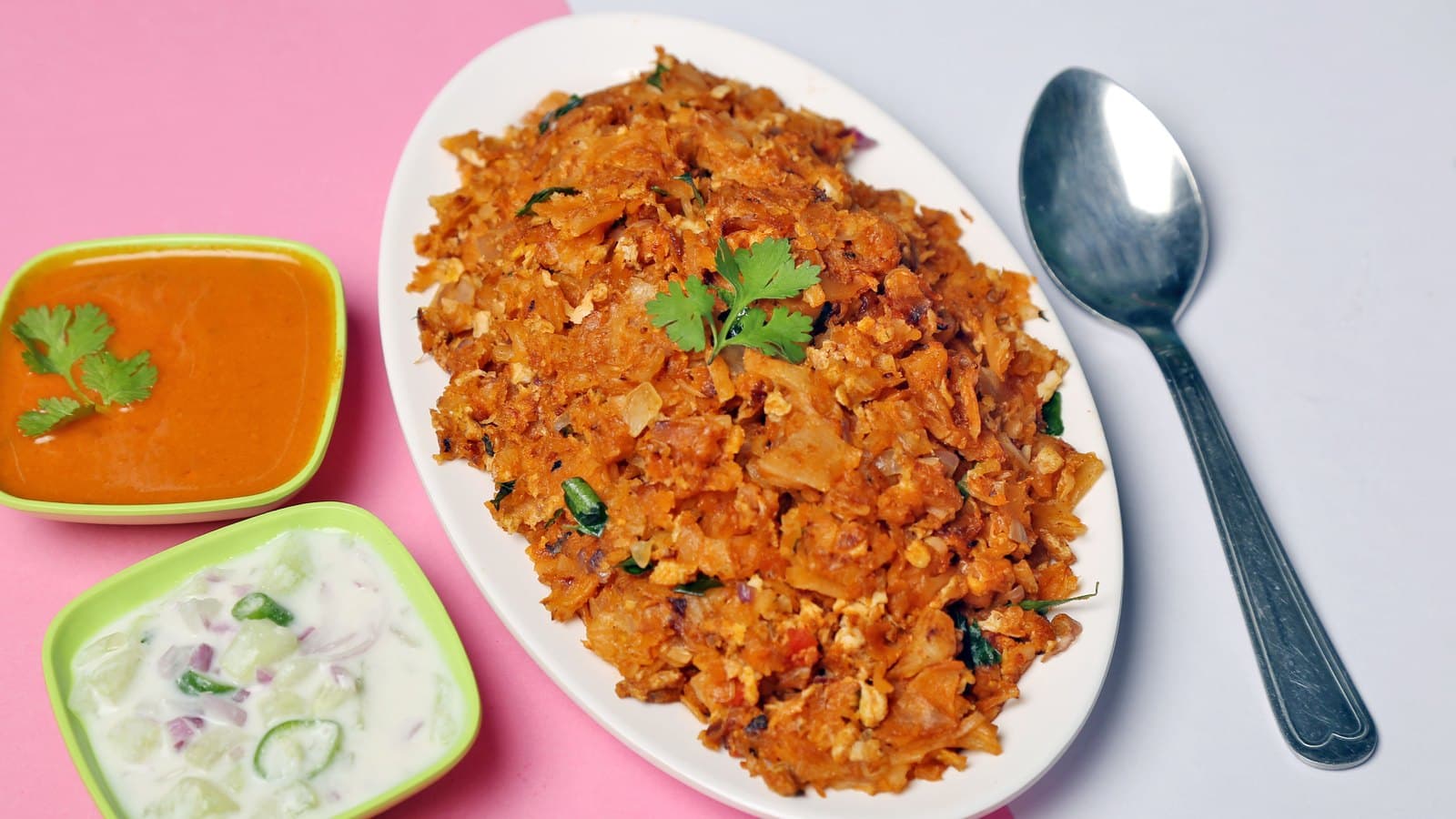
Nobody at a kottu shop weighs anything. The rotis hit the hot plate, the blades come down, more oil goes on when it sticks, and what lands in front of you is however much the cook decided to make. Search for the calorie count and you get exact figures from AI-generated sites that contradict each other by hundreds of calories and cite nothing checkable.
A real published number does exist here, which is unusual. The Sri Lankan Food Composition Database, described in a 2025 peer-reviewed paper, publishes a value for chicken kottu as a finished dish, more than exists for rice and curry, where no composite figure is published at all.
What it cannot tell you is how much is on your plate, how heavy-handed your shop is with the oil, or what cheese does. So: the published anchor first, then the plate taken apart, every source named and every proxy labelled.
Table of Contents
- The One Published Number for Kottu
- Godamba Roti: The Biggest and Least Documented Term
- The Oil on the Hot Plate
- Chicken, Egg and the Protein Side
- Leeks, Carrot and Cabbage: The Rounding Errors
- Cheese Kottu Is a Different Dish
- The Gravy Poured Over the Top
- The Whole Plate at a Glance
- Two Sourced Numbers That Disagree
- Why Two Plates of the Same Kottu Differ
- How to Estimate Your Own Plate
- FAQ
- The Bottom Line
The One Published Number for Kottu
The Sri Lankan Food Composition Database (foodcompositiondb.lk) lists "Chicken Kottu Roti" as item 31: per 100 g, 176.36 kcal, 8.17 g fat, 14.48 g carbohydrate, 6.45 g protein, 4.46 g fibre and 341.82 mg sodium. It comes from the Institute of Research and Development, Sri Lanka, under the UK Medical Research Council funded CoTaSS-3 project, and is described in Opatha et al., Journal of Food Composition and Analysis, 140, 107230 (2025).
The caveat matters as much as the number. The paper's own method describes values compiled by data extraction, cooking to local recipes and recipe calculation, so this is a calculated value for one representative recipe, not a measurement of your shop's kottu.
No authority publishes a serving mass either. The database works per 100 g and leaves portion size blank for the user; USDA FoodData Central has no kottu record at all, in any data type. Every gram weight below is our assumption, and that is the largest uncertainty here.
| Plate size assumed | Calories at 176.36 per 100 g | Fat at 8.17 g per 100 g |
|---|---|---|
| 350 g, a modest plate | ~617 kcal | ~29 g |
| 400 g, a common restaurant plate | ~705 kcal | ~33 g |
| 500 g, a generous plate | ~882 kcal | ~41 g |
| 600 g, a large or shared size | ~1,058 kcal | ~49 g |
Every extra 100 g is about 176 kcal, and an assumed 400 g plate carries roughly 1,367 mg of sodium.
Godamba Roti: The Biggest and Least Documented Term
The roti is the biggest calorie term, and no published value for godamba roti exists. USDA has no record, and the Sri Lankan database has none either: searching it for roti returns only Coconut Roti and the kottu entry itself.
So, a labelled proxy: frozen whole wheat paratha, 326 kcal and 13.2 g fat per 100 g, 79 g a piece, about 258 kcal per piece (USDA FDC 174076). Both breads are laminated with fat and griddle-cooked; plain chapati (FDC 171844, 297 kcal) is leaner.
Both caveats push the estimate high. The record is whole wheat where godamba roti is refined white flour, so its 9.6 g of fibre per 100 g is far too generous; and it is dry at 33.5 g water per 100 g, making it more energy-dense per gram than roti sitting inside a finished kottu. Three rotis is 237 g and roughly 773 kcal before anything else touches the plate.
The Oil on the Hot Plate
Coconut oil is 892 kcal and 99.1 g fat per 100 g, about 121 kcal per 13.6 g tablespoon (USDA FDC 171412). That value is solid. What nobody publishes is how much goes onto the griddle and into your portion, and the cook re-oils freely whenever the mixture catches.
One tablespoon versus three is a 240 kcal swing on a single plate, invisible in the finished dish and in any photograph of it.
Which oil hardly matters: the USDA record for soybean salad or cooking oil, what is sold as plain vegetable oil, is 884 kcal per 100 g, about 120 kcal a tablespoon (USDA FDC 171411), against coconut oil's 121. The saturated fat profile differs, but the calorie total follows quantity, not variety.
Chicken, Egg and the Protein Side
Shredded chicken uses USDA roasted broiler chicken, meat only: 190 kcal and 7.41 g fat per 100 g with 28.9 g of protein (FDC 171054). A proxy, standing in for meat pulled off a Sri Lankan curry, which carries gravy oil the record does not include. Light meat is 173 kcal per 100 g (FDC 171466), dark meat 205 (FDC 171069).
That makes the chicken far less calorie-dense than the terms that dominate the plate, 190 kcal per 100 g against the roti's 326 and the oil's 892, and easily the most protein-dense thing on it.
Egg is raw whole egg, 143 kcal and 9.51 g fat per 100 g, about 72 kcal for a 50 g large egg (USDA FDC 171287). Raw is the right basis because the frying oil is already counted on its own line; a fried-egg record would double-count the fat.
Leeks, Carrot and Cabbage: The Rounding Errors
Raw leek is 61 kcal per 100 g (USDA FDC 169246), carrot 41 (FDC 170393) and cabbage 25 (FDC 169975). An equal-thirds blend is about 42 kcal per 100 g, the assumption behind the vegetables line below. Raw records are fairer because kottu vegetables are flash-cooked on the plate, not simmered.
A 70 g cup of shredded cabbage is about 18 kcal, less than a sixth of one tablespoon of the oil it is fried in.
Which is why vegetable kottu is not automatically light: dropping the chicken removes about 190 kcal per 100 g of meat and changes nothing about the roti or the oil. No published value for vegetable kottu exists in any source we checked, so any figure must be built from components and labelled as such.
Cheese Kottu Is a Different Dish
No authority publishes a cheese kottu value, and the amount is entirely at the cook's discretion. The ingredient is sourced: US pasteurised process American cheese, 366 kcal and 30.7 g fat per 100 g (USDA FDC 170853), a proxy for the processed slices Sri Lankan shops melt in.
Two slices add roughly 155 to 205 kcal, depending on whether the slice is 21 g or 28 g. A 113 g cup of shredded cheese adds about 414 kcal and 34.7 g of fat, more than doubling the fat of a 400 g plate. Cheese kottu is not chicken kottu with a garnish; it is a materially different calorie proposition wearing a similar name.
The Gravy Poured Over the Top
The gravy has no published Sri Lankan value. The closest proxy is the USDA survey recipe for chicken curry, 107 kcal and 6.48 g fat per 100 g, about 128 kcal for a half-cup 120 g ladle (FDC 2706437), the same record our rice and curry post uses.
Treat it as a defensible middle, not a measurement: kottu gravy is often thinner than a served curry, so the proxy may overstate it. It also goes on after plating, which makes it the easiest thing in the meal to forget.
The Whole Plate at a Glance
The build assumes three rotis, 100 g of chicken, one large egg, 100 g of vegetables and two tablespoons of oil: about 514 g before any gravy.
| Component | Portion assumed | Honest estimate (kcal) | Source basis |
|---|---|---|---|
| Godamba roti, paratha proxy | 3 pieces (237 g) | ~773 | USDA FDC 174076, proxy |
| Coconut oil on the hot plate | 2 tbsp (27.2 g) | ~242 | USDA FDC 171412 |
| Shredded chicken | 100 g | ~190 | USDA FDC 171054, proxy |
| Egg, whole | 1 large (50 g) | ~72 | USDA FDC 171287 |
| Leek, carrot and cabbage | 100 g mixed, equal thirds | ~42 | USDA FDC 169246, 170393, 169975 |
| Build subtotal | ~514 g, no gravy | ~1,319 | Sum of the rows above |
| Curry gravy | Half-cup ladle (120 g) | ~128 | USDA FNDDS 2706437, proxy |
| Processed cheese, modest | 2 slices (21 to 28 g each) | ~155 to 205 | USDA FDC 170853, proxy |
| Processed cheese, generous | 1 cup shredded (113 g) | ~414 | USDA FDC 170853, proxy |
| Published chicken kottu value | Per 100 g as served | ~176 | Sri Lankan FCDB item 31 |
Two Sourced Numbers That Disagree
The build gives about 1,319 kcal for 514 g, roughly 256 kcal per 100 g. The published figure is 176.36. Both are sourced, they disagree widely, and the honest move is to say so rather than quietly pick the flattering one.
Water explains much of it: the paratha proxy holds 33.5 g per 100 g against 63.92 g in the finished kottu record, and water dilutes energy per gram without changing the ingredients. The rest is our own assumptions, since the published recipe likely uses less oil and more vegetable per roti than a three-roti, two-tablespoon build.
Use both. Take 176.36 kcal per 100 g as the anchor for a plate as served, and the build as an upper bound showing where the calories sit. A shop heavy with the oil bottle and generous with the roti sits closer to the build.
Why Two Plates of the Same Kottu Differ
Three levers do nearly all the work. Plate size, since every extra 100 g is about 176 kcal and regular-to-large is usually a whole extra roti at roughly 258 kcal. Oil, at about 121 kcal a tablespoon and completely invisible. Cheese, the only add-on that can add several hundred calories by itself.
Not on that list: the meat. Swapping chicken for vegetables removes about 190 kcal per 100 g and leaves both dominant terms untouched, the opposite of the intuition most people bring to ordering. None of it shows up in the dish's name, or in a photograph.
How to Estimate Your Own Plate
Eyeballing food is hard even for professionals. In the Nutrition5k study (Thames et al., CVPR 2021), trained nutritionists estimating dish mass by sight averaged 41 percent error. Consistency, not precision, is the realistic goal.
- Judge the plate mass first, then use roughly 176 kcal per 100 g as your anchor.
- Count the rotis if you can, since each is about 258 kcal on the paratha proxy.
- Allow extra if the shop is heavy-handed with oil, roughly 121 kcal a tablespoon.
- Log the gravy separately; it arrives after plating and gets forgotten.
- Treat cheese kottu as a different dish, not chicken kottu plus a little extra.
- Do not assume vegetable kottu is lighter; the roti and the oil are unchanged.
This chopped, mixed, unmeasurable kind of plate is what general-purpose food databases handle badly, the same structural problem we covered for Indian cooking in our guide to the best calorie counter for Indian food. CountNutri lets you photograph the meal; the AI calorie counter identifies what is on the plate, estimates the portion, and returns calories plus protein, carbohydrate and fat cross-checked against USDA FoodData Central, with every item adjustable in a tap. The 7-day free trial includes 1 AI scan a day, 7 scans in total; Premium is $9.99 a month and Ultra $99.99 a year, about 2 months free, each with 6 scans a day. It runs on Android and in the browser. For how the mainstream trackers cope with this food, see our MyFitnessPal alternative for Sri Lankan food comparison.
FAQ
How many calories are in a plate of kottu?
The Sri Lankan Food Composition Database publishes 176.36 kcal per 100 g for chicken kottu, but nobody publishes a serving mass. On assumed sizes, 350 g is about 617 kcal, 400 g about 705 and 600 g about 1,058. Those gram weights are our assumption, not a standard.
How many calories are in one godamba roti?
None is published in USDA FoodData Central or the Sri Lankan database. Using paratha as a labelled proxy (USDA FDC 174076), a 79 g piece is about 258 kcal with 10.4 g of fat, though that proxy is whole wheat and dry, so it likely overstates a soft godamba roti.
Is vegetable kottu lower in calories than chicken kottu?
Somewhat, but less than people expect, and no published vegetable kottu value exists in any source we checked. Removing 100 g of chicken saves about 190 kcal; the roti and the oil that dominate the plate do not change.
How many calories does cheese kottu add?
Nobody publishes a figure, and the amount is up to the cook. Using US processed cheese as a proxy (USDA FDC 170853), two slices add roughly 155 to 205 kcal, and a cup of shredded cheese about 414 kcal and nearly 35 g of fat.
Why do calorie sites give such different numbers for kottu?
Because most of them are guessing. USDA has no kottu record at all, and the top results are AI-generated pages publishing contradictory figures with no traceable method. Where no composite value is published, confident precision is a warning sign.
The Bottom Line
Kottu is one of the few Sri Lankan dishes with a real published composition value, and 176.36 kcal per 100 g is the honest place to start. What it cannot tell you is your plate size, your shop's oil habit, or whether cheese was involved, and those three separate a 620 kcal dinner from a 1,050 kcal one. Estimate the mass, count the rotis, allow for the oil, log the gravy separately, and take a consistent estimate over a precise-looking invention.
Ready to stop guessing at your own plate? Try CountNutri free.
Count calories from a photo instead
CountNutri reads your whole plate — including the mixed, home-cooked dishes that database apps break on — and returns calories, protein, carbs and fat in seconds, cross-checked against USDA data. Free 7-day trial, no credit card.